Solving the clean energy challenge for the off-grid world
When we discuss the green shift, the conversation usually revolves around smart cities, EV chargers, and massive wind farms connected to national grids. But what about the places that aren’t connected? What about the 65 million people living in island communities, or world-leading industries operating in the world’s most inaccessible fjords?
For them, the green transition isn’t a theoretical debate—it’s a matter of licence to operate, economic growth, and breaking free from the "diesel bottleneck."
The Norwegian energy company Alotta has taken on a mission as simple as it is monumental: bringing clean energy to where the grid doesn't reach. Not in 2050, but today.
Innovation isn't a better generator. It's no generator at all.
Every day, across the globe, remote industries and communities rely on diesel to keep the lights on and the wheels turning. It is expensive, noisy, polluting, and it deepens the climate crisis with every liter burned. But perhaps most importantly: diesel is a barrier to social and economic development.
In areas lacking renewable infrastructure, the cost of diesel logistics becomes a hard ceiling on growth. When your energy supply depends on a barge fighting the elements to deliver fuel to a generator, you are tethered to the past.
"Today, most operations in remote areas run on diesel. It’s polluting, it’s noisy, and it weighs down companies’ carbon accounts," explains Alotta CEO Kari-Elin Hildre. "Many have ambitious sustainability goals, but the alternatives simply haven’t been accessible or reliable enough for them to make the switch."
"Today, most operations in remote areas run on diesel. It’s polluting, it’s noisy, and it weighs down companies’ carbon accounts. Many have ambitious sustainability goals, but the alternatives simply haven’t been accessible or reliable enough for them to make the switch."
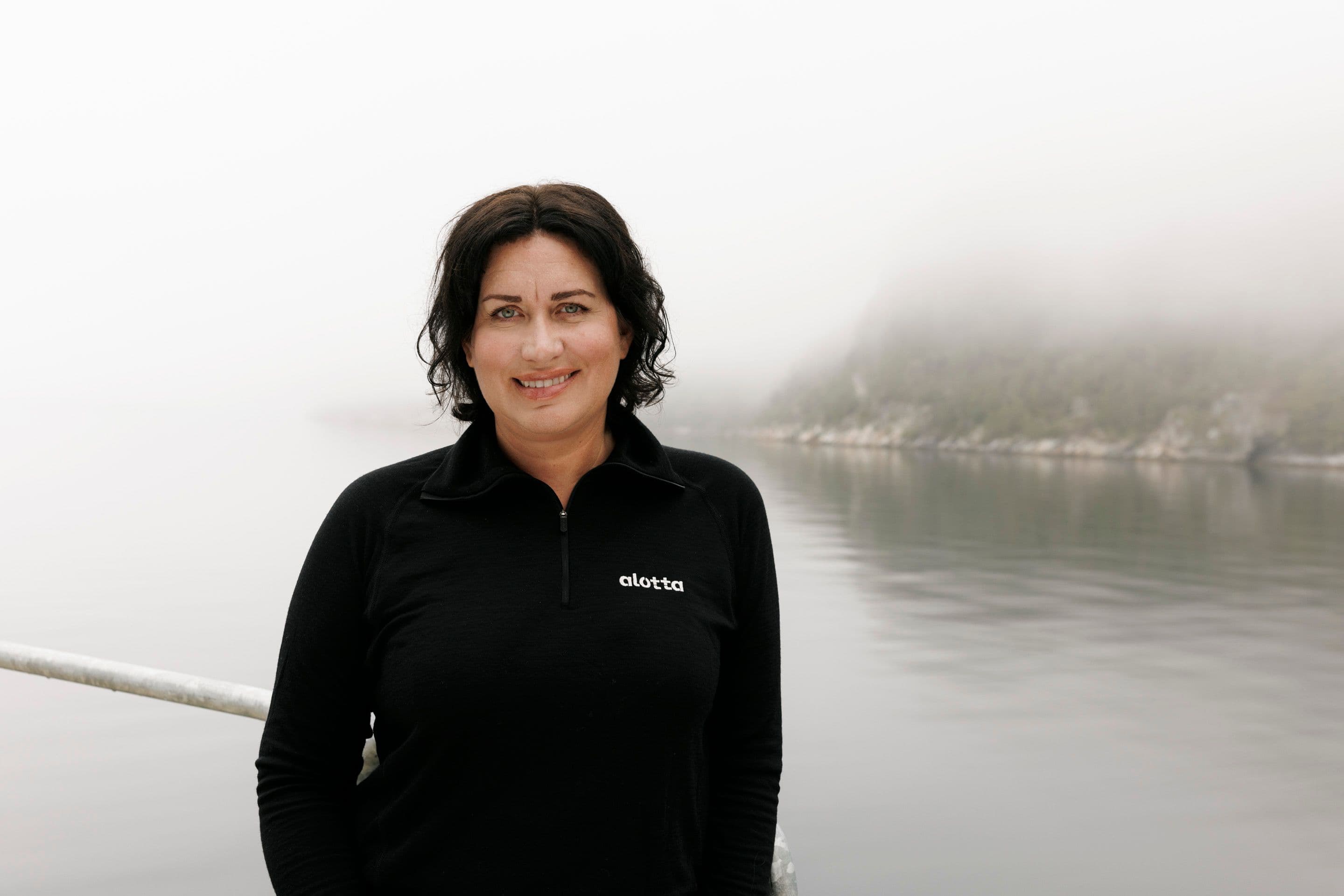
Alotta is changing this dynamic by attacking the problem head-on with robust technology and a business model that removes the biggest barrier of all: investment risk.
The floating clean energy revolution
At the heart of Alotta’s solution are their floating energy systems. By utilizing water surfaces, whether in Norwegian fjords or along the coast of Chile, Alotta delivers stable power without the need for large-scale interventions in vulnerable land areas or complex approval processes.
However, as innovative companies often discover, technology alone isn't enough to trigger a shift. The real "game-changer" is Alotta’s business model: Energy-as-a-Service (EaaS).
Instead of a salmon farmer in Chile or a hospital on a Pacific island having to invest millions in solar arrays and learn complex operations, Alotta allows them to simply buy power. Alotta owns, installs, and operates the systems through long-term contracts. The customer pays only for the kilowatt-hours they use, just like a standard utility bill.
This removes the burden of technology choices and heavy CAPEX from the client, making the transition from diesel to solar seamless and logical.
From aquaculture to island nations
Alotta’s journey began in the Norwegian aquaculture industry, a sector highly focused on decarbonization. This success became the springboard for international expansion, with Chile as the first major market outside Norway. Chile’s aquaculture industry, one of the world's largest, relies heavily on diesel generators in areas where the grid is nonexistent.
But aquaculture is only the tip of the iceberg. The need for decentralized, renewable energy is pressing for all remote industries—and especially for island communities.
There are over 1,000 inhabited islands worldwide, often classified as Small Island Developing States (SIDS). These communities are currently at the mercy of imported fossil fuels. For them, Alotta’s solutions mean more than just electricity for schools and hospitals; they mean independence from fossil fuels and a hope for a sustainable future that doesn't compromise economic welfare.
Innovation with courage
For CEO Kari-Elin Hildre, Alotta’s mission is personal. With a background in the maritime, oil, and gas industries, she has seen firsthand how the world operates when dependent on fossil fuels.
"To be part of a company that’s driving that shift, concretely and measurably, is a once-in-a-lifetime opportunity," she says. She describes the technology as "poetic" - a solar power plant that moves gently with the waves, using sun and sea to solve a global crisis.
But she is also clear that innovation at Alotta isn't about taking wild bets. It’s about what she calls "innovation with courage": having the determination to solve difficult engineering problems in extreme environments.
"We work in highly exposed environments, with harsh weather and strong waves. But our technology has proved robust; the systems hold up even through seasonal storms."
This courage was evident when the company chose to scrap a previous technological path in favor of a superior solution. It was a major upgrade that required the guts to change course to achieve the long-term goal of becoming a fully integrated clean-energy provider.
The path forward
Alotta is currently evolving from a system supplier into a total clean-energy provider. Backed by a solid roster of investors, the company is scaling operations in Chile and beyond.
Through strong local partnerships, such as with AKVA Group in Chile, they secure the necessary infrastructure and operational capacity to succeed internationally. This is the core of Alotta’s strategy: combining Norwegian engineering excellence with local expertise to create real change where it matters most.
"Joining Alotta—whether as a partner, a customer, or a supporter—is an opportunity to shape an entirely new business model and a new market from the ground up," Hildre concludes.
The world needs better energy. Not tomorrow, but now. And where the grid ends, Alotta steps in.
KPI
Intro
Tekst
Tittel
Desc 2